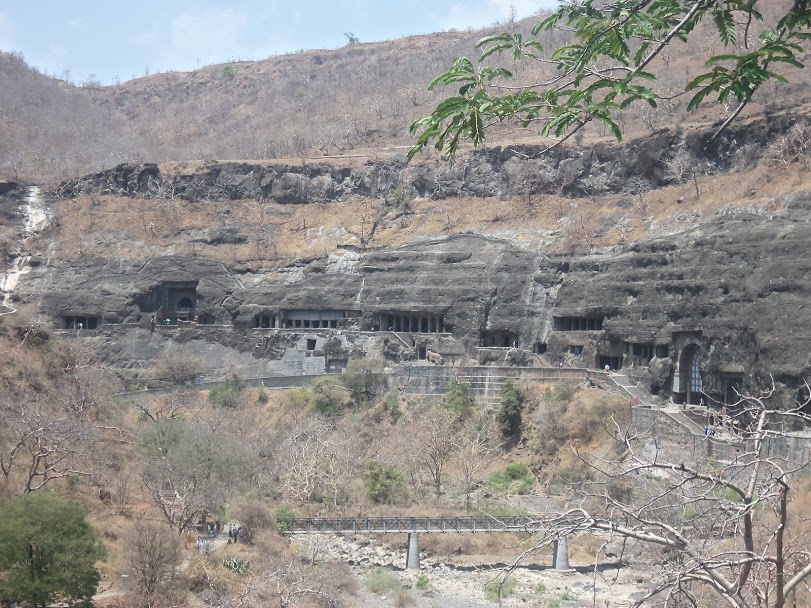
In childhood, I often heard the stories of The Ajanta Caves which was carved through a Hard Rock Mountain. I always get fascinated by the thought that how can a man carve an Entire Mountain to make the residential viharas and worship halls for monks.
I wanted to experience it on my own.
Some years back, I got a chance to visit an Aurangabad city to attend a family function, so I decided to fulfill my childhood wish of visiting the Ajanta caves as well.
The site of the caves is nearly 102 km away from a hustle and bustle of an Aurangabad city. I hired a taxi and started a journey towards these amazing Caves.
My first stop was a view point, from actually where the British officer john smith discovered these caves in 1839. John was on a tiger hunting party when he reached this point which, is exactly opposite to the cave site and from where the horseshoe shape of the cave is clearly visible.
These caves were built during Wakataka Dynasty by Buddhist Monks during the period of 200 BC to 650 AD. The beautiful wall paintings and sculptures inside the caves depict the various aspects of Gautam Buddha’s life and stories from Jataka tales.
The monks mastered the art of painting and sculptures to promote the teachings of Gautam Buddha amongst the students studying there.
Exploring the caves:
Cave 1 is adorned with many beautiful paintings of the stories from Jataka tales based on Buddha’s Reincarnation. The great idol of Lord Buddha is one of the main attractions of this cave. It shows the different expressions of the Lord when viewed from different sides. For example it shows Serious expression from right side, austerity from left side and peace from front side of the idol.
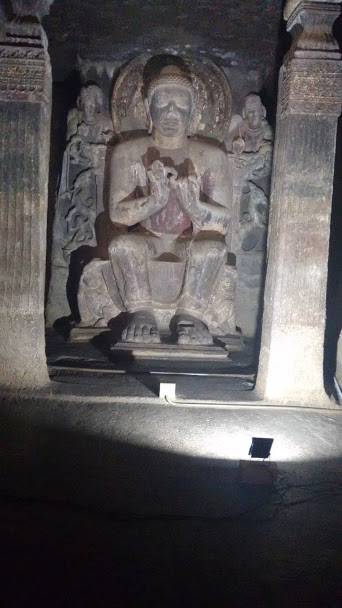
On the outer wall of the temple is the painting of a peacock which is believed to be the god of love, which is preventing Lord Buddha from achieving his goal.
The world famous painting of Gautam Buddha, “Panamanian” is painted in the first cave. This painting is as famous as some Italian paintings of a same era. The lotus flower in Lord Buddha’s hand is a sign of Peace and Purity.
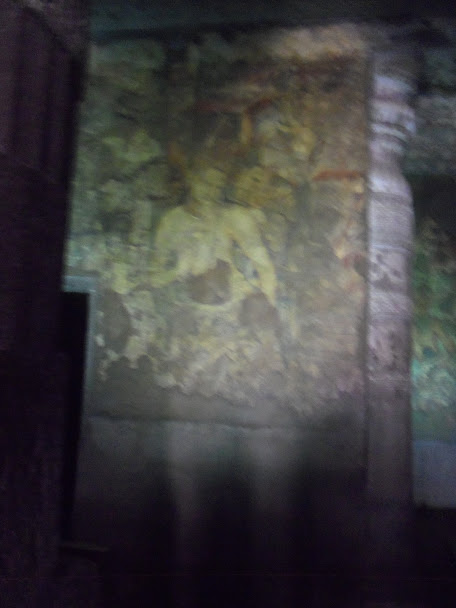
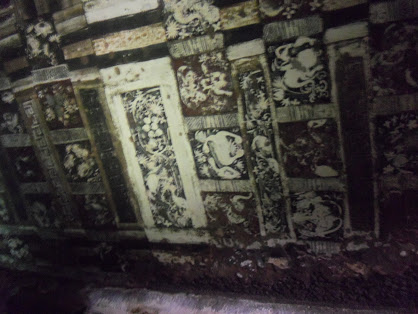
On the left hand side of the cave is a painting of king Shivi, in which he is saving a pigeon from a falcon bird. Painting of Various Flowers, birds and Fruits are made to beautify the roof of the cave.
In cave 2 On the left hand side the idol of Lord Buddha is carved through its wall. On the left side of the idol is a painting of Lord Buddha’s mother, in which she tells her husband about her dream. The next painting shows birth of Gautam Buddha; and his parents showering their love on him.
The pair of janitors at the entrance of cave 4 welcomes you all inside the biggest cave of Ajanta. 6 big idols at the shrine are saving us from the 8 great fears of life.. This cave was built in 6th century CE and was used as a vihara by monks.
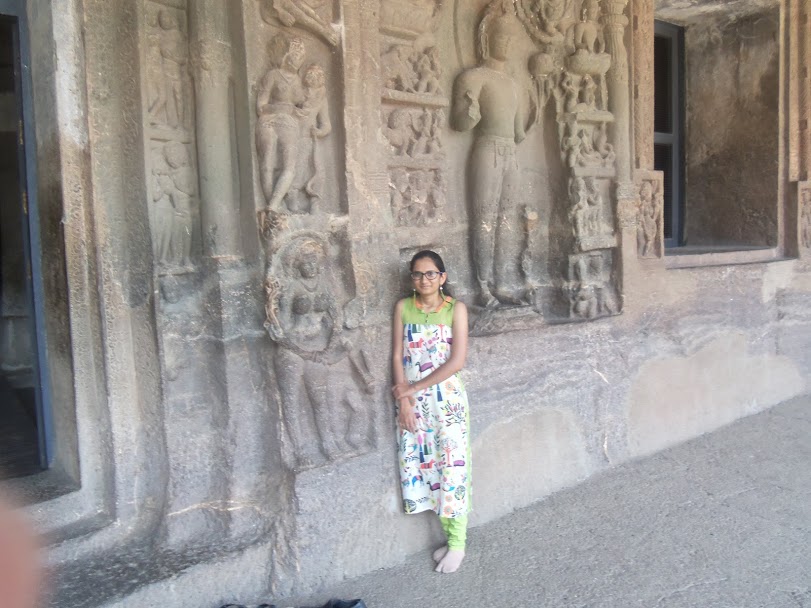
Cave 6 is a two storeyed cave, with an idol of Lord Buddha in a hall on the ground floor and has some pillars in the hall on second floor. Entrance gate on the second floor of the cave is decorated with beautifully carved arches. Cave 7 has an idol of Lord Buddha at the shrine; on the backside of an idol an Areola i.e. a circle of light or brightness surrounding something, especially head or body of a person represented as holy has been made.
In Cave 9, there is a Stupa in the center of Chaitya, which is carved in a single stone. Some Unclear paintings on the wall, shows various expressions of Lord Buddha. Cave 10 is a Hinyan temple and it has a Stupa inside it, on which some compositions are written in a Pali language. According to these compositions, this cave was constructed in 200 BC. Cave 11 has a big hall with a Lord Buddha’s idol at the shrine.
Cave 16 occupies a prime position near the middle of a site. It has a huge entrance gate on which some beautiful carvings and arches are made, which is enough to tell you about the importance of this cave.
The first thing you will see after entering the cave is, big idol of Lord Buddha at the shrine and a wonderful painting of the famous Kathakali dance form..
On the left hand side of the cave is the painting of Lord Buddha’s cousin King Nanda, who has become monk. In the next painting Nanda’s mother can be seen, who fell unconscious after knowing that her son has become a Monk.
On the right side of a cave is a painting in which Gautam Buddha’s mother can be seen, who is telling her husband about her dream and an astrologer is interpreting it. Other carvings in the cave include the Elephants, Horse, and a crocodile.
Cave 17 has two great stone elephants at the entrance. This cave features a large and most sophisticated vihara design, along with some of the best-preserved and well known paintings of all the caves.
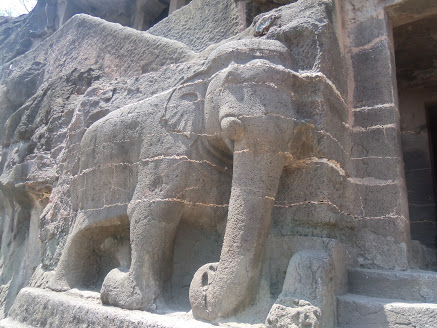
Its worship hall is very beautiful and it also has a Lord Buddha’s idol at the shrine. On the left wall of a shrine is a painting of Gautam Buddha’s previous birth, in which he was shown as an Elephant.
Gautam Buddha has been shown in another painting seeking his alms from his wife Princess Yashodhara and son Rahul. Lord Buddha has held a big body, and the princess Yashodhara and Rahul have been shown to be smaller than them.
At the worship hall king Harisen and his minister Varahadev was shown holding a lamp in front of Lord Buddha, it means that, they will illuminate the whole world with Lord Buddha’s message. The ceiling of this cave is decorated very beautifully; it looks like a piece of cloth with a big border to it. Many fairy tales are painted on the ceiling of this cave.
Cave 19 is horse-shoe shaped temple; It has some idols of Lord Buddha. a Painting of king Nagraja and his wife is also there. On the left side is a picture of Gautam Buddha, who is asking for alms, to his wife and son. There is also a Stupa with three umbrellas, on which idols of Lord Buddha are carved.
In this partly incomplete cave 21 are some beautifully carved pillars. There is a large painting of Gautam Buddha on the left side wall depicting that, he is giving discourse to his students.
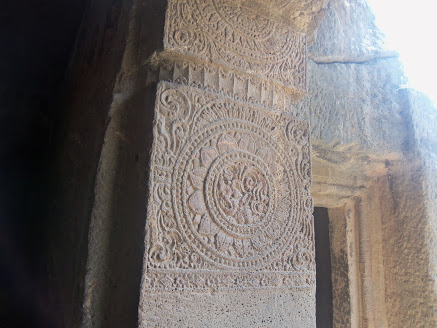
Cave 24 is the biggest cave of Ajanta; in terms of the area, but unfortunately it’s incomplete. If this cave does not leave incomplete, it would have been the best cave amongst all. Its artistic charm and grandeur is commendable. The veranda of this cave is carved with very special sculptures like, god of water, King Nagraja and gate guards.
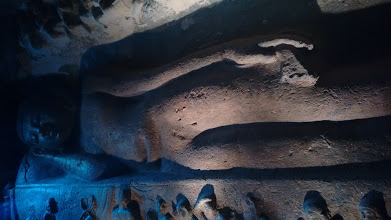
Cave 26 has two very important sculptures. The artwork begins on the wall of the aisle, immediately the left side of entrance. The major artworks include the Mahaparinirvana of Buddha (reclining Buddha) on the wall, followed by the legend called the “Temptations by Mara”. The temptations include the seduction by Mara’s daughters who are depicted below the meditating Buddha.
Some of the caves are incomplete and some are partly incomplete, it seems that the excavation of these caves begun right at the end of the final period of work and soon abandoned. For Example cave 3, cave 5 and cave 8 are totally incomplete. Caves 12 to 15 have nothing special in it. Cave 18 has a small lake inside it and its role is unclear.
Cave 22 is an incomplete cave. Yet there is a very beautiful painting on the right side, in which seven Manushi Buddhas are shown sitting under a BodhiVruksha.
Cave 23 has some pillars, with beautiful carvings on them. Cave 25 is an incomplete vihara, with no shrine or rooms it just have a small courtyard. Cave 27 is a very small cave, it seems to be a part of cave 26 itself. It is a two storeyed cave, whose ground floor is broken and second floor is also incomplete.
Cave 28 and 29 are the last two caves of the Ajanta, these caves does not have stairs to reach up-to them.
I went to Ajanta caves just to watch that, how someone did carved the mountain and made the caves. After visiting the caves i realized that, no matter what religion you follow what culture you have been born and brought up in, Buddha’s teachings are universal. His teachings have the strength to awaken people to reality and make them introspect themselves. Lord Buddha’s teachings have not only given a deeper insight into one’s existence, but also made significant contribution in liberating one from the day-to-day conflicts in minds.
Altogether it was a mesmerizing experience. I will definitely come here once again.
If you also want to come to Aurangabad city and visit The Ajanta caves here is the guide.
How To Reach:
By
Road:
Aurangabad is only 102 km from Ajanta. You can hire a local taxi or travel by
the state-run buses to reach the Ajanta Caves. The highway that connects
Aurangabad to Mumbai is also well-connected to various parts of the country
such as Delhi, Indore, Bijapur, Udaipur and Jaipur.
By
Rail:
Aurangabad is well-connected to Mumbai and Pune by rail. The Jalgaon Station is
the closest rail head. If you disembark at this station, you can opt for local
transport to tour the Ajanta Caves.
Shopping:
There are quite a number of souks outside both the Ajanta caves. If you are looking for fabrics, silver, semi-precious stones, beads and local, hand-carved sculptures of Buddha, then this is the place to be! Local images and paintings of various Hindu Gods along with Buddha, and even Jain, paintings can be found here.
Eating
Out:
The walk through the Ajanta Caves is quite a task and can also make you very
thirsty. Throughout the journey, there are local food stalls and counters were
soft drinks, fresh juices and snacks are sold. If you are looking for
restaurants, then this cave site have MTDC restaurant that serves a delectable
array of food, refreshments and drinks to get you prepped for the rest of the
day.
 Unending Voyage
मस्त झालाय अजंठाचा ब्लॉग..माझं राहूनच गेलंय ते बघायचं..आता तू इतकं छान वर्णन केल्यावर तर लवकरच जावं वाटायला लागलंय
LikeLiked by 1 person
नक्की लवकर जाऊन ये …
LikeLike